As of mid-June 2025, the global economy finds itself at a critical crossroads, shaped by ongoing macroeconomic adjustments, structural shifts, and geopolitical developments. While inflation rates are easing across many advanced economies, risks remain in the form of persistent monetary tightening, geopolitical instability, and sluggish investment recovery. This article explores key trends and forecasts for the global economy, based on data available through June 20, 2025.
1. United States: Balancing Resilience with Fiscal Pressures
The U.S. economy has demonstrated notable resilience in H1 2025, with GDP growth expected to reach 2.1%, supported by strong consumer spending, labor market stability, and continued investments in technology and clean energy. The Federal Reserve has maintained interest rates but signaled possible rate cuts later in the year depending on inflation trends.
Inflation has eased to just above 3%, though still above the Fed’s 2% target. Unemployment has edged up to 4.5%, indicating a gradual rebalancing in the labor market. However, the primary challenge lies in the widening federal budget deficit, which has surpassed $1.8 trillion.
This deficit stems from sustained military spending, rising healthcare and social security costs, and insufficient revenue adjustments. The fiscal imbalance undermines the government’s ability to stimulate the economy during downturns and has increased sovereign borrowing costs. Credit rating agencies have issued warnings, while political gridlock hinders comprehensive fiscal reforms. Over the long term, this threatens private investment and could erode confidence in the U.S. dollar if debt sustainability comes into question.
2. Eurozone: Fragile Recovery and Policy Adjustments
Economic expectations for the eurozone remain subdued. Industrial slowdowns in Germany and Italy contrast with tourism-led recoveries in southern countries like Spain and Greece. The European Central Bank cut its main interest rate by 25 basis points in June 2025, with further easing expected in Q4.
Annual inflation has stabilized around 3.2%, driven by service and energy sectors. Overall growth is projected at just 0.8% in 2025. Structural issues, including labor market rigidity, low productivity, and lagging digital and green transitions, continue to constrain long-term performance.
3. China: Resetting Growth Amid Structural Challenges
China is rebalancing its economy toward domestic consumption, targeting GDP growth of 4.6% in 2025—below its official target. The real estate sector remains fragile, while exports are impacted by trade tensions and weak global demand.
The government has responded with moderate fiscal stimulus and infrastructure investment, yet underlying issues persist: high local government debt, youth unemployment exceeding 14%, and regulatory uncertainty, particularly in tech. Ongoing tensions with the U.S. and other Western countries further complicate external economic relations.
4. Emerging Markets: Divergent Growth Paths
Emerging markets display a mixed picture. Commodity exporters like Brazil and Mexico benefit from high resource prices and stable inflation, although political instability and income inequality pose risks.
India stands out with growth forecasts above 6.5%, fueled by digital expansion, manufacturing growth, and infrastructure upgrades. Southeast Asia, led by Vietnam and Indonesia, remains resilient, albeit sensitive to China’s performance.
Conversely, many African economies face heavy debt burdens, currency weakness, and limited fiscal space. However, lower inflation is providing some central banks room to ease monetary policy cautiously.
5. Middle East and North Africa: Diversification Amid an Oil-Friendly Environment
Gulf Cooperation Council (GCC) countries, notably the UAE and Saudi Arabia, are pushing economic diversification through tourism, logistics, fintech, and renewables. Oil prices near $80 per barrel support fiscal surpluses and development projects.
Nevertheless, regional political tensions—such as conflicts in Yemen and Libya—pose downside risks. Strategic investments via sovereign wealth funds and public-private partnerships are bolstering resilience and long-term economic transformation.
6. Key Global Risks in 2025
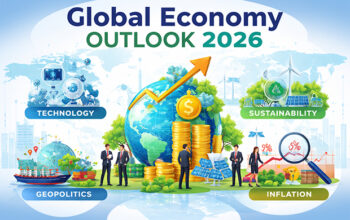
- Geopolitical conflicts: Ongoing war in Ukraine, South China Sea tensions, and Middle East instability.
- Climate change: Extreme weather events threaten food and water security, insurance systems, and infrastructure.
- Public debt burdens: Both advanced and emerging markets face refinancing challenges amid tighter financial conditions.
- Technological disruptions: AI, automation, and digital platforms are reshaping labor markets and affecting productivity and social equity.
7. Global Growth Forecasts
Global GDP is expected to grow by 2.9% in 2025, a modest improvement over 2024. Most of the growth will come from emerging and developing economies, while advanced economies slow. Inflation is generally declining but remains above target in several regions.
Central banks are gradually shifting toward neutral stances, while fiscal policies focus on targeted structural spending. There is rising investment in digital infrastructure, healthcare, clean energy, and resilient supply chains.
Conclusion
The global economy in 2025 continues to grapple with a complex mix of recovery and risk. Despite a rebound in growth and easing inflation, financial pressures, geopolitical uncertainty, and technological change remain significant hurdles. The U.S. fiscal deficit in particular signals broader concerns about debt sustainability in advanced economies.
Adaptability, policy coherence, and international cooperation will be key to securing long-term prosperity. Governments, businesses, and civil societies must work together to build more resilient, inclusive, and sustainable economic systems.
Note: This article is based on official data and projections available as of June 20, 2025.