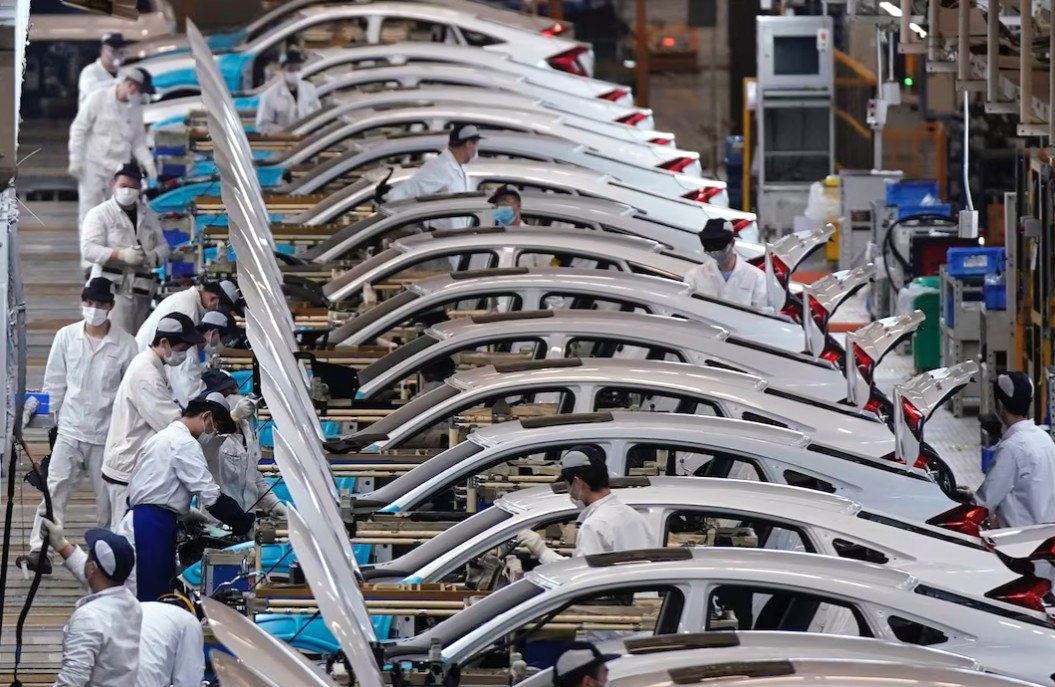
Reuters: Business News – As Western governments intensify their scrutiny of China’s fast-advancing electric vehicle (EV) sector, a quieter but equally transformative shift is unfolding across the global automotive landscape. According to a detailed report by Nick Carey for Reuters, Beijing’s long-established automakers are rapidly flooding emerging and second-tier markets with competitively priced fossil-fuel vehicles — a strategic move that is reshaping industry dynamics and, in many cases, undercutting their international joint-venture partners. This trend is redefining competition far beyond the EV race and signaling a broader realignment in global auto market priorities.
While political attention in the U.S. and Europe remains centered on Chinese EV dominance — from battery supply chains to aggressive subsidies — China’s traditional automakers are facing a different reality at home. As Reuters highlights, EVs have surged to more than half of China’s domestic market, creating intense pressure on legacy manufacturers that built their success on internal-combustion engines (ICE). Once-powerful names such as Chery, Dongfeng, and Changan now struggle to compete with a new generation of Chinese EV leaders like BYD, NIO, XPeng, and Zeekr.
With domestic demand for petrol-powered cars collapsing, these legacy automakers are turning outward. Reuters notes that 76% of China’s car exports since 2020 have been fossil-fuel vehicles, a staggering figure that reflects both global demand patterns and China’s internal industry restructuring. In fact, even without counting EVs, China’s export volumes for ICE vehicles alone would still make it the world’s largest automotive exporter — surpassing Japan and Germany.
These vehicles are not heading to Western capitals, however. They are flowing into regions where EV adoption remains limited due to infrastructure, affordability, and policy constraints. Markets across Latin America, Eastern Europe, Central Asia, Africa, and the Middle East are increasingly populated with brand-new Chinese petrol cars, often available at prices far below competing models. In countries such as Russia, Mexico, Chile, South Africa, Uzbekistan, and Egypt, China’s share of fuel-powered car imports has rapidly climbed.
Industry analysts cited by Reuters emphasize that this strategy is not accidental — it is a deliberate repositioning. By exporting millions of ICE vehicles, Chinese automakers are monetizing excess production capacity, maintaining factory utilization, and gaining market share in regions largely ignored by Western manufacturers. This is particularly impactful in markets where global automakers have scaled back investments or shifted focus exclusively to electrification.
The long-term implications are profound. While the West debates tariffs and EV standards, China is quietly building dominance in the very markets expected to experience the fastest automotive growth through 2035. This dual-track strategy — EV leadership in the developed world and ICE saturation in the developing world — gives Beijing’s automakers a powerful global footprint that extends far beyond the clean-energy transition narrative.
As Reuters’ Nick Carey underscores, China is not just competing in the EV revolution; it is reshaping the global auto ecosystem on multiple fronts at once.