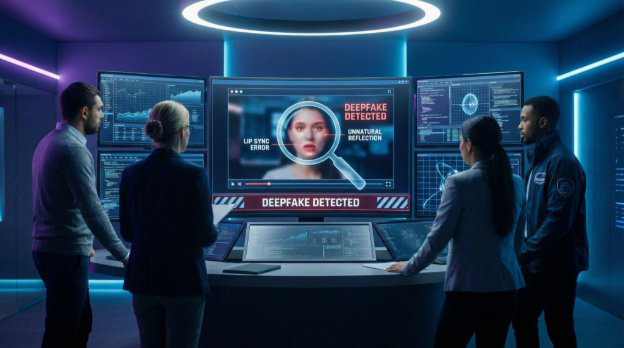
AI-generated content is expected to become more persuasive due to improving capabilities, increased user dependence, or training on user feedback, the latest Internet safety report claims. According to cybersecurity experts, these advancements will inevitably be used by cybercriminals.
February 25, 2026. Last week’s investigation into Musk’s social media platform X for sexualized deepfake images generated by its company Grok was yet another reminder of the dangers deepfakes pose for the public. Cybersecurity experts warn that aside from sexualized content, AI-generated images are also increasingly used for fraud, scams, and identity theft, and share tips on how to stay protected against the growing threat.
The ease with which a convincing video deepfake can be created was illustrated by the recent viral video where Hollywood actors Tom Cruise and Brad Pitt were fighting in a filmed scene. The filmmaker Ruairi Robinson, who shared the video on X, said that it was made from a 2-line prompt.
Meanwhile, the European Commission and a number of countries have recently started investigating Musk’s social media platform X over sexual images that were generated with its Grok chatbot.
According to experts at Planet VPN, a free virtual private network (VPN) provider with a strict emphasis on no-logs policy, these and similar AI tools also open the door for bad actors to speed their attacks. Konstantin Levinzon, co-founder of the company, stresses that the rise in AI-driven technologies has made it easier for malicious actors to deceive people on a scale never seen before.
“A particularly dangerous aspect of AI technologies is that they make it difficult to distinguish what’s real. The internet is flooded with fake images and videos, also known as deepfakes, which can be created in just seconds with low-cost or even free tools. Cybercriminals use deepfakes for a variety of attacks, from scamming people with fake videos to identity fraud and impersonation,” Levinzon says.
Companies are also not immune to the threat. According to Levinzon, bad actors target employees of businesses to trick them into unauthorized transfers with videos impersonating their CEOs. They also use fake images and videos to bypass online security, creating a growing challenge for financial institutions.
The latest International Safety Report notes that in the future, threats posed by AI-generated content will likely become bigger, as AI-generated content is expected to become more persuasive due to improving capabilities, increased user dependence, or training on user feedback.
Levinzon is certain cybercriminals will find ways to use new developments to their advantage and urge users to be mindful of these risks.
“While AI-generated content can be hardly distinguishable from reality, it often leaves trails. For example, in deepfake videos, there are unnatural facial movements, inconsistent lighting or shadows, blurring, or distortion around the face,” Levinzon explains.
“It’s worth noting that there are services that analyze images and videos for signs of AI generation. They look for artifacts, unnatural textures, and errors in details. However, it is important to understand that such tools provide a probabilistic result, not an exact verdict.”
He advises limiting the amount of personal video content shared online, as bad actors often use publicly available footage to create deepfakes and then target users. Protecting all of your accounts with multi-factor authentication is also essential. Once cybercriminals gain access to an account, they may post images or videos impersonating the user.
“A VPN network also significantly strengthens security. It encrypts your internet traffic, making it far more difficult for anyone, including your internet service provider, to monitor your online activity. By reducing data exposure, a VPN can lower the risk of being targeted not only by deepfake-related schemes, but also by other types of scams and fraud,” Levinzon says.